

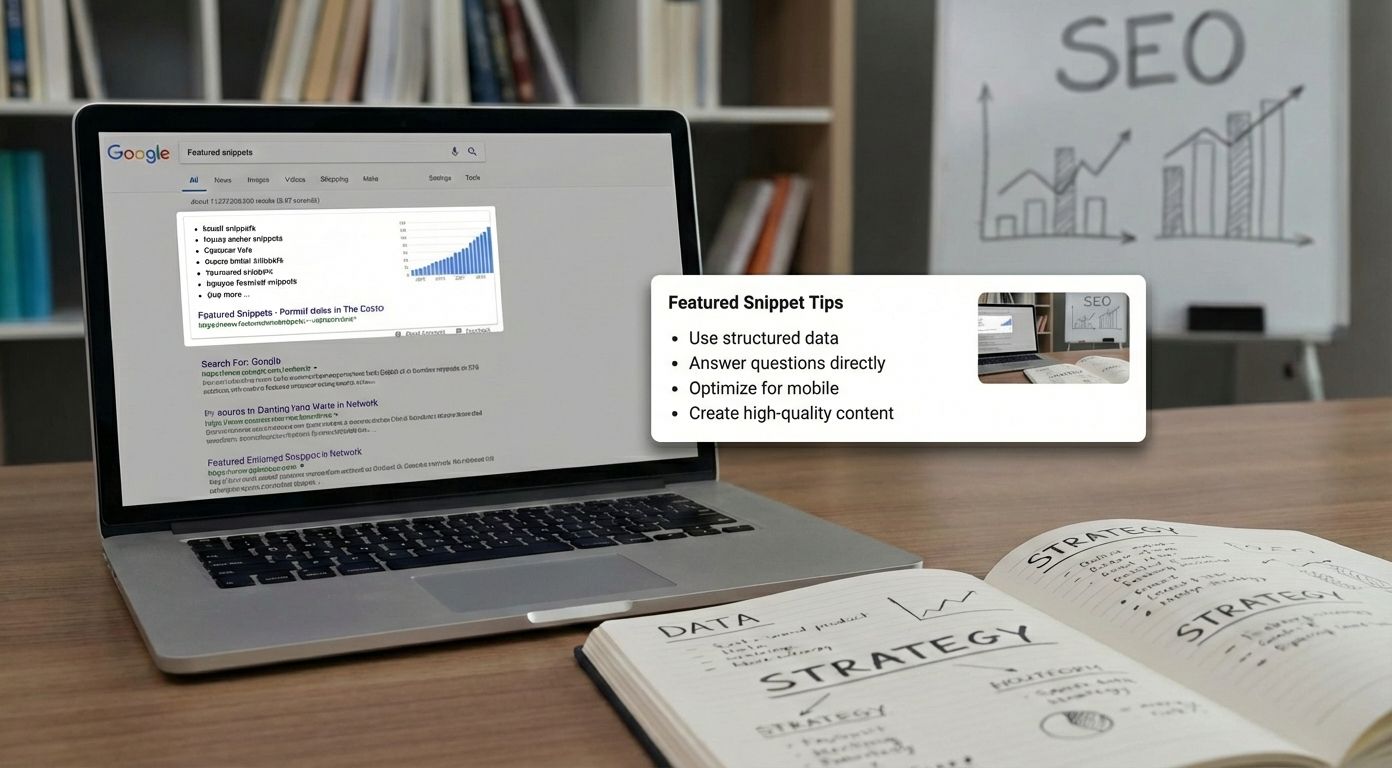
How to Get Featured Snippets: A Data-Driven Optimization Guide

Learn how to optimize for featured snippets with proven, data-backed strategies. Discover which content formats win Position Zero and how to structure your pages for snippet success.
What Is a Featured Snippet?
A featured snippet is a highlighted search result that appears at the top of Google's organic results—often called "Position Zero." Google extracts this content directly from a webpage to provide users with a quick, direct answer to their query.
Featured snippets appear in a distinct box above the traditional blue links, giving the source page significantly more visibility than standard results.
Why Featured Snippets Matter for SEO
The data speaks for itself:
| Metric | Impact |
|---|---|
| Click-through rate increase | 8-12% average lift over Position 1 |
| Organic traffic potential | 35% of all clicks on Page 1 |
| Voice search usage | 40% of voice search answers come from featured snippets |
| Brand visibility | 2x more SERP real estate than standard results |
Winning a featured snippet doesn't just improve your traffic—it positions your brand as the authoritative answer in your niche.
The 4 Types of Featured Snippets
Before optimizing, you need to understand which snippet format Google prefers for different query types.
1. Paragraph Snippets
The most common type, appearing in approximately 70% of all featured snippets. Google displays a text block of 40-60 words that directly answers a question.
Best for: "What is," "Why does," "How does" queries
Example query: "What is keyword cannibalization"
Optimal format:
[Question as H2 or H3]
[Direct answer in 40-60 words immediately following the heading]
2. List Snippets (Ordered & Unordered)
Account for roughly 19% of featured snippets. Google pulls bulleted or numbered lists to display step-by-step processes or item collections.
Best for: "How to," "Best," "Top," "Steps to" queries
Example query: "How to do keyword research"
Optimal format:
[Question/Topic as H2]
[Brief intro sentence]
1. First step
2. Second step
3. Third step
[Continue with 5-8 items]
3. Table Snippets
Represent approximately 6% of featured snippets. Google extracts tabular data to display comparisons, pricing, specifications, or statistics.
Best for: Comparison queries, "vs," pricing, data lookups
Example query: "SEO tools pricing comparison"
Optimal format:
[Topic as H2]
| Column 1 | Column 2 | Column 3 |
|----------|----------|----------|
| Data | Data | Data |
4. Video Snippets
Growing in prevalence, particularly for tutorial and how-to content. Google displays a video thumbnail with a suggested timestamp.
Best for: Visual tutorials, demonstrations, reviews
Example query: "How to set up Google Search Console"
How to Find Featured Snippet Opportunities
Not every keyword triggers a featured snippet. Your first step is identifying which of your target keywords have snippet potential.
Step 1: Identify Keywords Already Triggering Snippets
Use a rank tracking tool to filter for keywords where:
- A featured snippet currently exists
- You rank on Page 1 (positions 1-10)
- You don't currently own the snippet
Keywords where you already rank in the top 10 are your highest-probability opportunities. Data shows that 99.58% of featured snippets come from pages already ranking on Page 1.
Step 2: Analyze the Current Snippet Holder
For each opportunity, examine:
- Snippet type: Is it paragraph, list, table, or video?
- Content format: How is the winning content structured?
- Word count: How long is the snippet text?
- Heading usage: What heading precedes the snippet content?
- Page authority: What's the Domain Rating/Authority of the current holder?
Step 3: Assess Your Competitive Position
Ask yourself:
- Is your existing content more comprehensive than the snippet holder?
- Can you provide a more direct, better-formatted answer?
- Does your page have comparable or better authority metrics?
If you answer "yes" to at least two of these questions, the snippet is worth pursuing.
8 Data-Backed Strategies to Win Featured Snippets
1. Match the Query Format Exactly
Google's algorithm looks for content that directly mirrors the searcher's question. The data is clear: pages that include the exact query (or a close variant) as a heading are 2-3x more likely to win the snippet.
Implementation:
- Use the target question as an H2 or H3 heading
- Place your answer immediately after the heading
- Don't bury the answer under introductory fluff
Example structure:
<h2>What Is a Featured Snippet?</h2>
<p>A featured snippet is a highlighted search result that appears
at the top of Google's organic results, displaying extracted content
that directly answers the user's query.</p>
2. Use the "Snippet Bait" Technique
Snippet bait is a 40-60 word block specifically crafted to be extracted by Google. This paragraph should:
- Begin immediately after your target heading
- Provide a complete, standalone answer
- Use clear, declarative language
- Avoid first-person pronouns
- Not include your brand name
Optimal snippet bait formula:
[Term/concept] is [definition/explanation] that [primary function/purpose]. [Additional context in 1-2 sentences]. [Key benefit or distinguishing factor].
Word count guidelines by snippet type:
| Snippet Type | Optimal Length |
|---|---|
| Paragraph | 40-60 words |
| List items | 5-8 items |
| Table | 3-5 columns, 4-8 rows |
3. Structure Lists for Extraction
For list-based snippets, formatting is everything. Google's parser looks for clear HTML list structures.
Do this:
<h2>How to Optimize for Featured Snippets</h2>
<p>Follow these steps to increase your chances of winning Position Zero:</p>
<ol>
  <li>Research existing snippets for your target keywords</li>
  <li>Identify the snippet format Google prefers</li>
  <li>Create content that matches the preferred format</li>
  <li>Use proper HTML heading hierarchy</li>
  <li>Place your answer immediately after the heading</li>
</ol>
Avoid:
- Paragraphs formatted to look like lists
- Lists embedded within other elements
- Inconsistent list formatting
4. Build Comprehensive "Hub" Pages
Analysis of over 2 million featured snippets reveals that longer, more comprehensive content wins snippets more frequently than thin pages.
Optimal content characteristics:
| Factor | Recommendation |
|---|---|
| Word count | 1,500-2,500 words |
| Headings | 8-15 H2/H3 subheadings |
| Answer coverage | Address 5-10 related questions |
| Internal structure | Clear hierarchy with jump links |
The key insight: Google often pulls snippets from pages that answer multiple related questions—not just the primary query.
5. Target Question Keywords
Featured snippets disproportionately appear for question-based queries. Analyze your target keywords and prioritize those beginning with:
| Question Word | Snippet Likelihood | Common Snippet Type |
|---|---|---|
| How | High | List, Paragraph |
| What | Very High | Paragraph |
| Why | High | Paragraph |
| When | Medium | Paragraph, Table |
| Where | Medium | Paragraph |
| Who | Medium | Paragraph |
| Which | Medium | List, Table |
Strategy: For each primary keyword you target, identify 5-10 question variations and address them with properly formatted answers within your content.
6. Implement Schema Markup
While schema markup doesn't directly cause Google to select your content for a featured snippet, it helps Google understand your content's structure and purpose.
Relevant schema types for snippet optimization:
- FAQPage: For pages answering multiple questions
- HowTo: For step-by-step instructional content
- Table: For comparison and data content
Example FAQPage schema:
{
  "@context": "https://schema.org",
  "@type": "FAQPage",
  "mainEntity": [{
 "@type": "Question",
 "name": "How do you optimize for featured snippets?",
 "acceptedAnswer": {
 "@type": "Answer",
 "text": "To optimize for featured snippets, identify keywords triggering snippets, analyze the current snippet format, create content matching that format, use the target question as a heading, and place a 40-60 word answer immediately after the heading."
 }
  }]
}
7. Improve Page-Level Authority Signals
Even perfectly formatted content won't win snippets without sufficient authority. Data shows the correlation between snippet ownership and:
| Authority Signal | Correlation |
|---|---|
| Page in top 5 positions | 99%+ of snippets |
| Referring domains to page | Strong positive |
| Domain authority | Moderate positive |
| Content freshness | Moderate positive |
Action items:
- Build links to your target pages
- Ensure strong internal linking from related pages
- Update content regularly to maintain freshness signals
- Remove or improve low-quality pages dragging down site quality
8. Optimize for Multiple Snippet Opportunities Per Page
A single well-structured page can win featured snippets for dozens of related queries. This "snippet clustering" strategy maximizes your ROI from each piece of content.
Implementation:
- Identify your primary keyword cluster
- Research all question variations within that cluster
- Create a comprehensive page with H2/H3 sections for each question
- Format each section as proper snippet bait
- Track which snippets you win and iterate
Example page structure:
H1: Featured Snippets: The Complete Guide

H2: What Is a Featured Snippet?
[Snippet bait paragraph]

H2: What Are the Types of Featured Snippets?
[Intro paragraph]
[List of types]

H2: How Do You Get a Featured Snippet?
[Snippet bait paragraph]

H2: How Long Should Featured Snippet Content Be?
[Snippet bait paragraph]

H2: Do Featured Snippets Increase Traffic?
[Snippet bait paragraph]
Featured Snippet Optimization Checklist
Use this checklist when optimizing any page for featured snippets:
Content Structure
- Target question used as H2 or H3 heading
- Answer appears immediately after heading (no intro fluff)
- Snippet bait is 40-60 words for paragraphs
- Lists contain 5-8 clearly formatted items
- Tables use proper HTML table markup
- Page addresses multiple related questions
Technical Requirements
- Page currently ranks on Page 1 for target query
- Content matches the existing snippet format
- Proper HTML heading hierarchy (H1 → H2 → H3)
- Relevant schema markup implemented
- Page loads quickly (under 3 seconds)
- Mobile-friendly formatting
Authority Signals
- Internal links from related high-traffic pages
- External backlinks to the target page
- Content updated within the last 12 months
- Author expertise signals (bio, credentials)
Common Featured Snippet Mistakes to Avoid
1. Targeting Snippets You Can't Win
If your page ranks on Page 2 or beyond, focus on improving overall rankings first. Chasing snippets from Position 15 is wasted effort.
2. Ignoring the Existing Snippet Format
Google has already determined the ideal format for each query. If the current snippet is a list, don't submit paragraph content and expect to win.
3. Writing for Search Engines, Not Users
Snippet bait that reads unnaturally or stuffs keywords will hurt your chances. Google evaluates the quality and clarity of your answer, not just its structure.
4. Forgetting to Track Results
Snippet ownership is volatile. You might win a snippet one week and lose it the next. Set up monitoring to track your snippet wins and losses over time.
5. Optimizing Only One Section
Pages that answer multiple related questions outperform single-answer pages. Build comprehensive resources, not thin snippet-bait pages.
How to Track Your Featured Snippet Performance
Measuring your snippet optimization efforts requires tracking:
- Snippet ownership: Which snippets do you currently own?
- Snippet opportunities: Which keywords trigger snippets where you rank top 10?
- Traffic impact: How does winning/losing snippets affect your organic traffic?
- Click-through rate: Are your snippets driving clicks or satisfying users in the SERP?
Most rank tracking tools allow you to filter keywords by SERP features, including featured snippets. Set up a saved segment for:
- Keywords where featured snippets exist
- Keywords where you own the snippet
- Keywords where you rank 1-10 but don't own the snippet
Monitor this segment weekly and prioritize optimization for high-volume opportunities where you're close to winning.
Key Takeaways
Winning featured snippets is a systematic process, not a guessing game:
- Start with Page 1 rankings—99% of snippets come from top 10 results
- Match the existing format—paragraph, list, or table
- Use the query as your heading—place the answer immediately after
- Write 40-60 word snippet bait—clear, direct, no fluff
- Build comprehensive pages—target multiple related questions
- Track and iterate—snippets are volatile, monitor weekly
Featured snippets represent one of the highest-ROI opportunities in modern SEO. With the right approach, you can systematically capture Position Zero for dozens of keywords—driving visibility, traffic, and authority for your brand.
Target Keywords
- how to optimize for featured snippets
- how to rank for featured snippets
- featured snippets
- what is a featured snippet
- how to get a featured snippet
- position zero
- snippet optimization
Last updated: February 2026
Related blog posts
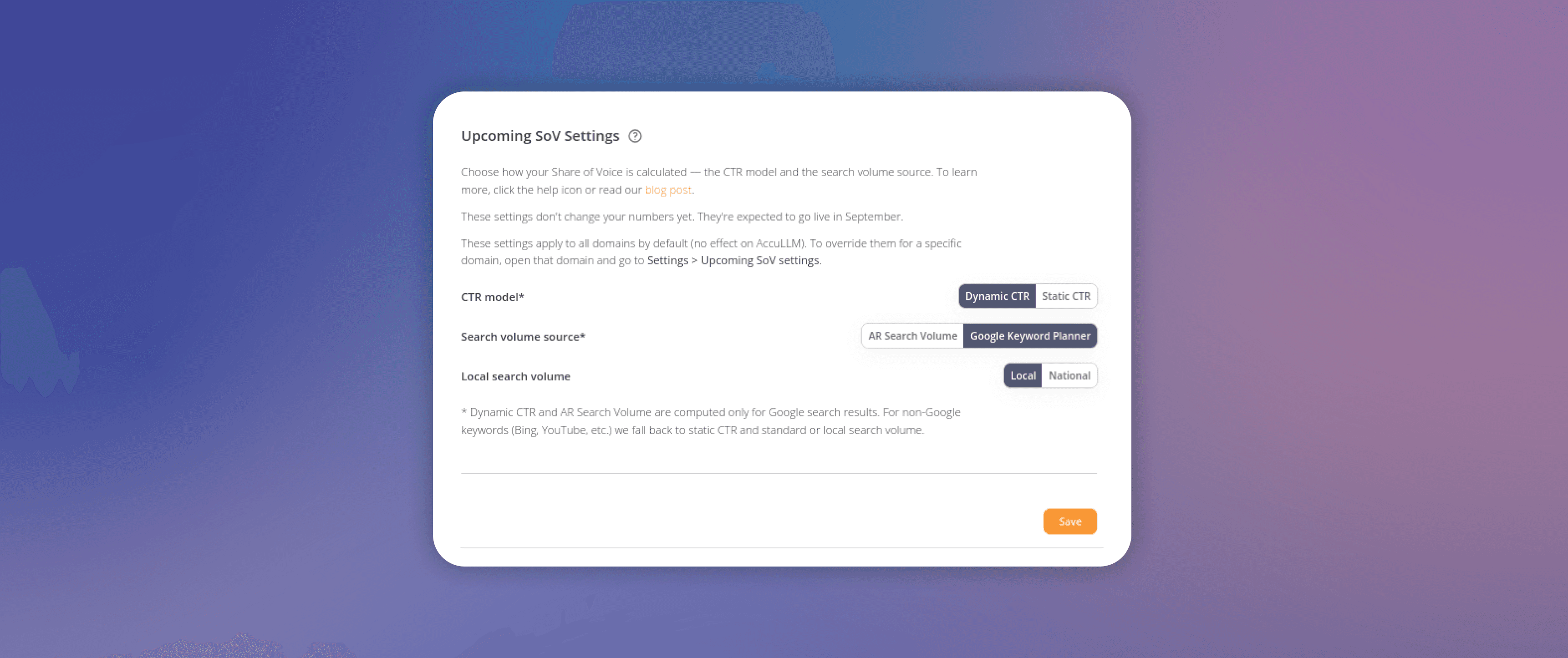
Share of Voice Update
We are changing how our Share of Voice metrics work. Read more about what we are changing and what you have to do.
2 July 2026
Why You Need Pixel Tracking to Determine Your Visibility
The SERP decides who gets seen, not your ranking alone. Pixel tracking is what you need to know whether users are likely to see your result.
2 July 2026
How to Analyze Your Brand Mention in AI Responses
Being mentioned in AI responses is only the beginning. We give you 6 factors to consider when analyzing your brand mentions and AI visibility.
18 June 2026